Saturday Side Note is when I take a break from testing out products and other beauty musings to talk about something else – something typically not beauty-industry related, at least not on the surface – that I love and that inspires me.
I have to say, I am starting to super love my Saturday Side Notes. It’s a good mood booster, to think about something you love for an extended period of time, trying to articulate exactly what you like about it. Today, I’m gonna go over a different – some may say almost opposite – side of me, which is the educator/teaching side. Education was my college major, and I’ve worked with kids in some capacity almost constantly since I was about 15.
Now, when I say “teacher,” I think most people immediately get some sort of image in their head. Those looming, not-related-to-you adults that were in charge of you for eight hours day, every day, for nine months per year, for thirteen years . . . They’re obviously going to influence you in a lot of ways, for better or for worse. No matter what you think of your education, whether the very thought sends shivers down your spine . . .

Or whether your teachers are the reason you’re a successful, compassionate human being, taking your smart-ass, ragamuffin self and changing you into the sweet bunny we knew you were . . .

Or, hell, even if your teachers were fine and made no impression on you at all . . .

. . . one thing I’ve found being on the other side of education (the helpful side! the eternally exhausted and wanting to weep side!), is that most teachers (including me) are fundamentally good people who are trying their best, take it super to heart when they screw up, and are constantly scrutinizing, reconsidering, adjusting, changing, and obsessing over how they do things to make sure you’re getting the best they can offer.
Teachers are big nerds, for the most part. And it isn’t just that they nerd out over the subject that they’re teaching; they also nerd out about how they teach it. Ooh, this new picture book is perfect! Ooh, a new game I can formulate to PERFECTLY fit today’s lesson!
(Oh, right, teachers are often perfectionists. This is why we hate it when you turn in sloppy work – we would never, so how dare you.)
ANYWAYS: My personal obsession is materials. I love, love, love teaching materials. And since I was mostly teaching very young kids, materials were of utmost importance. While for older kids, iPads and SmartBoards are, like, The Thing, for little kids it’s best to keep things incredibly simple. Keeping in mind that this is, in fact, a beauty blog, I’d like to discuss the beauty of my absolute favorite types of materials: Montessori.
Maria Montessori was an educator and physician who came up with an entire philosophy of education. We mostly see this philosophy utilized with toddlers and preschoolers, but you can make any curriculum Montessori-based, as it’s mostly in the how as opposed to the what. Meaning, there are specific materials frequently used that exemplify the Montessori method and teach children important skills. To sum up, because this isn’t about old Maria, Montessori is based in children working independently with specific materials (referred to as “work” or “works” in the classroom, not “toys”). Teachers’ job is to guide students to materials that are appropriate for their skill-level and, as said materials all made specifically to inspire practice of particular skills, help children expand the use of the material as they master different levels. This is the most basic way I can put it – I’m actually not Montessori-certified, so I don’t know the wording of things and words are hard.
What this means, basically, is that Montessori materials are the shit, so lemme get into why in more detail.
1.) First off, aesthetically-speaking, they’re beautiful and elegant. Also, they’re solidly made, mostly out of wood.


I don’t know about you, but I despise plastic toys, with their clangy-ness and their lack of ability to degrade on their own. Plastic shit is filling landfills, and I hate it. (And don’t @ me about your kid’s favorite plastic toy, I know you have to have SOME, and I also know that the light weight is a plus, but god, everything is made of plastic.) Montessori materials tend to be made of wood and are glazed/sanded in a way that they last, last, last. If you plan on having more than one kid, you really can’t go wrong with something like this.
Because the point of a Montessori work is often to start with one simple, basic concept, the materials themselves have a sort of sophisticated, timeless look to them that I adore. Not only that, because they’re made for small children to use independently, they tend to be small and easy to handle, so they don’t take up much space. They just don’t look as junky filling up a shelf as a over-sized plastic stuff does. The other reason for that is . . .
2.) Even works that require small parts have organization and streamlining built right in.


Color tablets and bead counting
We think of toddlers and preschoolers as messy, and that isn’t entirely unexpected. They tend to have poor fine motor skills, so they drop and spill everything; but honestly, I think more of the reason why we picture this . . .
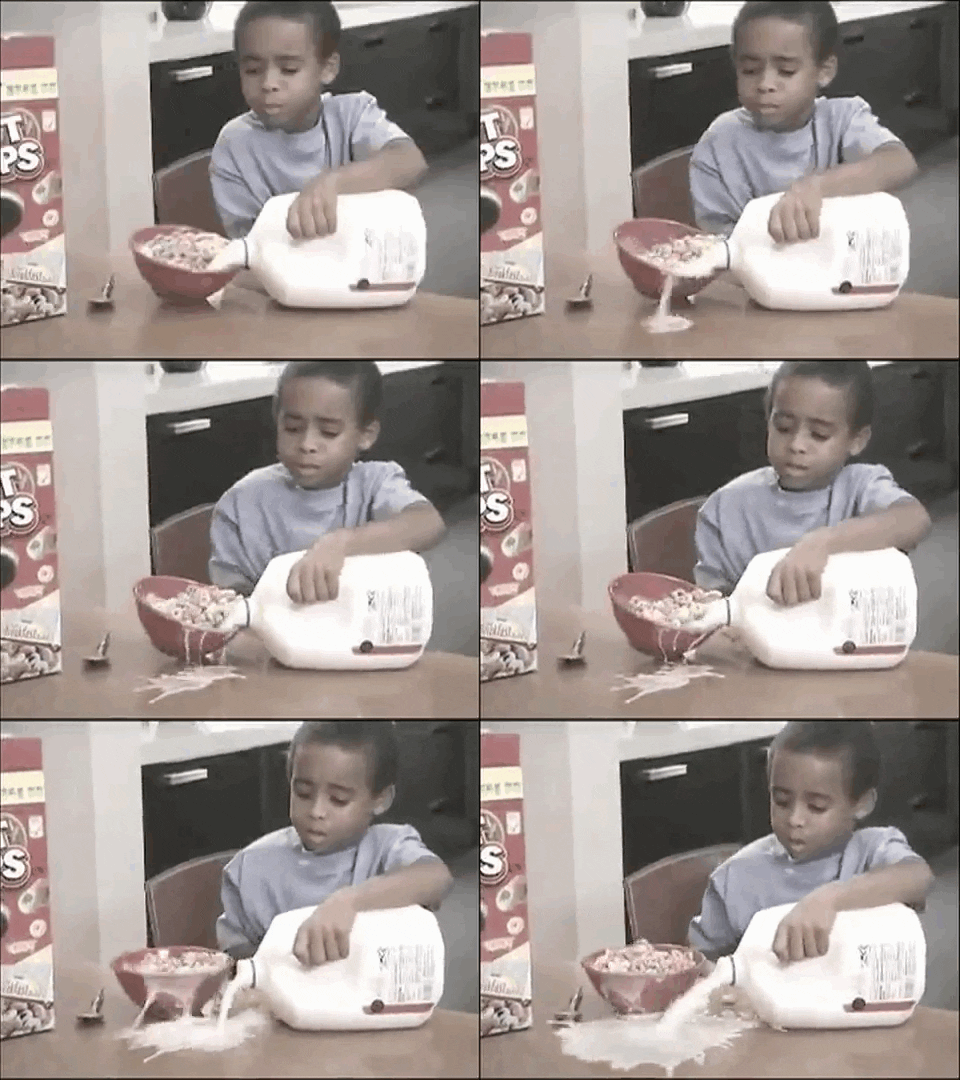
. . . is because 9 out of 10 times, they’re handling something that isn’t sized or made for them. As I said above, Montessori materials are meant to be used by kids without assistance from adults, and so are sized appropriately. Even when kids get to an age when choking hazards aren’t as much of concern, smaller, multi-object sets almost always come with a form of organization. Sometimes it’s a beautifully sectioned wooden box, or it’s a set of boxes or baskets that come in the exact number your child needs to categorize the materials appropriately.

Any website selling Montessori materials has an entire section of trays, baskets, boxes, tins, etc., that are quite lovely looking, should you be using a material (or making your own – more on that later) that requires simple storage and access.
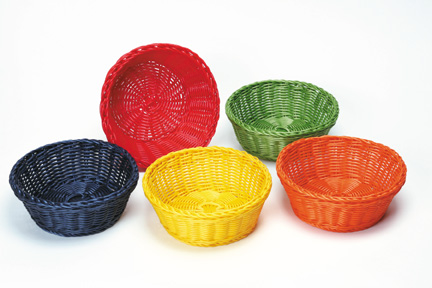
Basically, any Montessori materials website will have everything you need to make your kids toys – ahem, works – a part of your home instead of taking over it and making you want to cry into your Louis Vuitton when you trip on some stupid Princess Elsa thing.

Emphasizing independence for little ones means that the kids not only have to work with materials themselves, they also have to be able to put the materials away properly. Coming with components that keep items contained helps immensely with that aspect of the materials.
3.) Multifaceted, they grow with your child.
No, they don’t physically get bigger (unless your work consists of an aloe vera plant because apparently those things quickly take over your house), but despite their appearance of simplicity, Montessori materials are extremely complex and challenging. Take, for example, the most famous Montessori works, the Pink Tower and Brown Stairs.
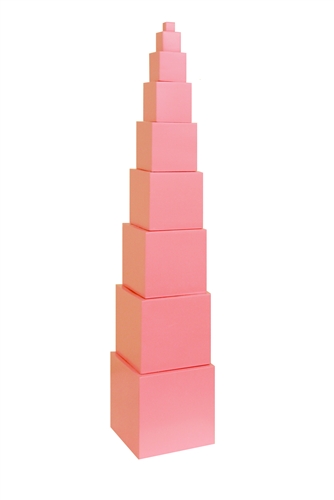
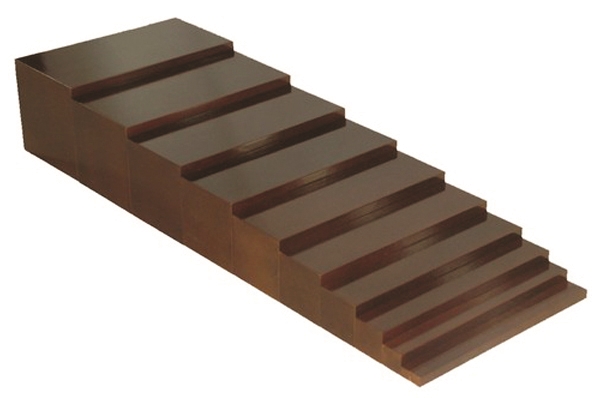
I mean, it doesn’t get more simple than that. And we might automatically think, “Fuck that’s boring.” (I can’t lie, I did.) But, but, but – the idea of size differentiation and dimension are only one aspect of these materials. As time goes on, students learn to stack them in various ways so that they don’t fall, basically getting their physics on. Also, they’re encouraged to use the materials to do different “extensions,” and end up making incredibly cool shit like this:


These are, of course, specific displays to create, but also kids will combine both materials to dream up their own amazing architectural feats. All of this helps kids get a feel for design, dimension, and objects in space, as well as practice their fine motor skills (like a cooler version of Jenga that doesn’t end in tears – most of the time).
4.) As much as possible, things are tactile and moveable.
It’s pretty obvious that toys for young kids would mostly be tactile, but most people don’t realize that you can make the practice of certain static skills physical as well. Reading, for example, usually consists mainly of the words on the page as well as writing down on a page. Two-dimensional, focused on drilling and, to me, incredibly boring. And I looooove reading. But Montessori reading and writing materials are extremely in-depth, forcing students to really “get in there” and move things. There are multiple sets of wooden letters to choose from, for kids to create words:

Also, it’s more fun to have a little zebra to put on a card that says “zebra” instead of just writing it over and over.

Rather than just immediately starting to practice writing the alphabet when the teacher feels they’re read, sandpaper letters are initially used for kids to trace before they actually begin writing; then, they move on to metal insets that have them trace the shapes and lines commonly used to create letters (and then they get to decorate them so that’s fun too):


The last thing I adore about Montessori materials is . . .
5.) They’re easy to make yourself! (If you’re into that – and hoo boy, am I into that!)
All of the above reasons why I love these works are actually what make them so easy to create yourself. They’re simple and are made from pretty standard materials, teaching incredibly basic concepts. While I might not want to try my hand at making a Montessori physics work, vocabulary, math, and practical life are areas in which a person could easily provide the tools to their kids or students. Remember that animal alphabet work above? Well, I made a few different sets of that for my friends’ kids for Christmas last year:


Just took some computer research for pics, put them into little cards, print, laminate, ta-da! Craft store bridal sections were where I got the burlap and canvas bags. I really wanted to make sure it all could be replaced into one small receptacle for easy transport and clean up.
Before that, I made a color sorting work that consisted of some ceramic plant stands and a bunch of painted wooden shapes. All of plant thingies stack, and go right into a bag with the objects. When you want to play, you take out and line up the little trays, and then you reach into the bag for an object and put it into the same color of tray. Ta-da! Easy to make, easy game for toddlers learning their colors.

The latest thing I’m working on is about the phases of the moon. The following photos are of the basic “prototype,” so to speak; I needed to figure out the best way of doing this and figured I should just make one and improve on it.


Yay! And just because I’m feeling bragalicious today, here are some shadow puppets I made that I’m still obsessed with, though they’re not really Montessori. I figure, it’s Halloween, so why not share ’em? Black construction paper, laminator (unless you use cardstock, which should be okay by itself), new/unused pencils as a stick for kids to hold. You don’t need a puppet theater, just get two chairs, put ’em a few feet apart, with a piece of butcher paper taped to them, and a desk lamp behind. The best creativity is dirt cheap.


So anyway – that’s my little ditty about Montessori materials! I truly believe every house should just have a few. Kids don’t need much for stimulation, and three dimensional objects to physically handle are actually becoming a novelty, with so many kids relying on two-dimensional TV and computer and iPad screens for entertainment. Even if you don’t have kids, I think that Montessori stuff makes great gifts for your nieces/nephews/weird-cousin’s-daughter-why-were-you-even-invited-to-this-birthday-party.
I tried to link each cool thing to where you could buy it, if you wanted, but if you missed one and/or just want to peruse, Montessori ‘N Such is my go-to. There’s also Alison’s Montessori as well, which is more school-based than Montessori ‘N Such, offering tables and shelves and playground equipment as opposed to just different materials/work. If you search “Montessori” on Etsy, there are a lot of beautiful, hand-made materials from sellers all over the world. So go and browse, and have fun!
 What the Hell is On My Face?