Saturday Side Note is when I take a break from testing out products and other beauty musings to talk about something else – something typically not beauty-industry related, at least not on the surface – that I love and that inspires me.
I’m a huuuuuuugggggeee bookworm, and have been since before I could even read for myself.
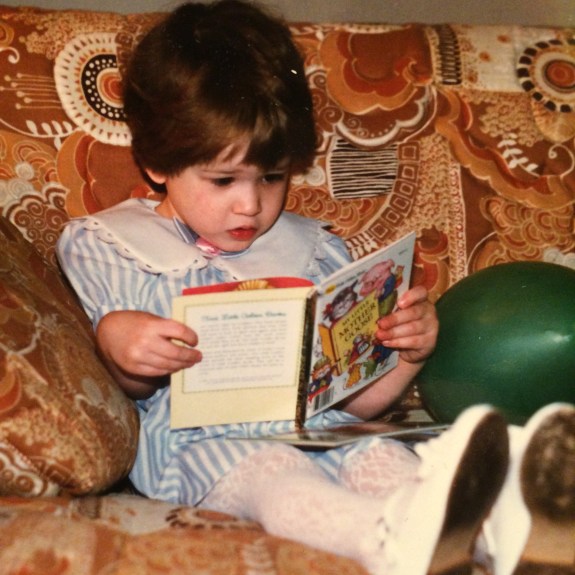
Back in the day, we’d go to Borders (they had, like, a café! and the fancy one downtown had a fireplace! Book paradise!), and I’d be able to get whatever I want. I was a good 90s kid with books: Babysitters Club, Sweet Valley Twins (Sweet Valley High was for cool kids who would lose their virginity way faster than me), Goosebumps, etc. I ripped through most of them pretty quickly, and constantly carried something “fun” while at school to pick up the second I finished my work.
Anyway – while my tastes have changed and levels of focus continue to vary, I still try to read as much as I can. There have been other books I wanted to write about for a Saturday Side Note, but most of them are pretty old and I sort of want this category a bit current. I received a recently published book for Christmas though and it was so unbelievably excellent I wanted to make sure I said something about it.
Killers of the Flower Moon by David Grann is about the Osage murders in Oklahoma, taking place in the early 1920s. Basic synopsis: The Osage (a tribe of Native Americans) bought land in OK that was considered pretty crappy in the eyes of white farmers because it was rocky and hilly. Fortunately, the land held incredible oil deposits, and the Osage as a result became extremely wealthy. This caused everyone’s racist to show (as if it weren’t showing already), and soon members of the tribe were being found murdered.
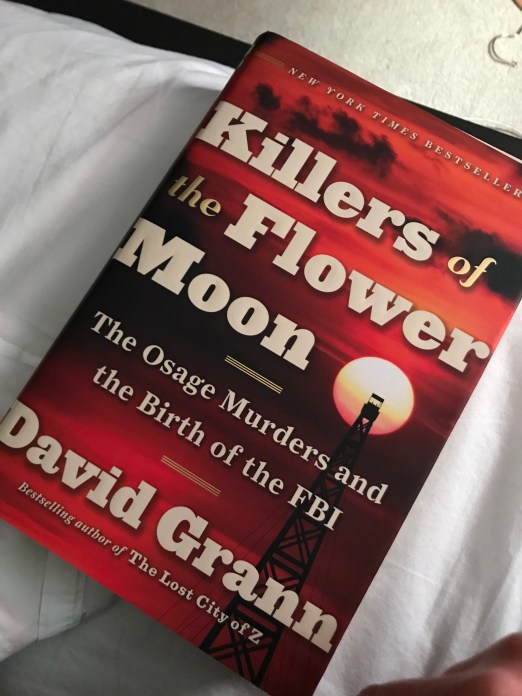
The murders central to the book, and encompassed under the descriptive title of “The Reign of Terror,” took place over only about four years, and the total number of killings (at the time) was estimated to be around thirty, but Grann considers at the end of the book how much greater this number could actually be. One Osage woman in particular, Mollie Burkhart, loses her mother, two sisters, and brother-in-law during this time period, and reading about her continuous tragedies is absolutely heartbreaking.
I originally wanted to read this because I love true crime, but typically am more into a sort of . . . true life noir? The standard dark-alley stuff, especially serial killers (sorry, Mom). More organized crime, I’m not into; nor does conspiracy really do it for me. However, there’s something about this entire book that just sort of ripped me to pieces. Grann does an incredible job of adding context to the central story of what is later referred to as the Reign of Terror. The story, on the surface, can seem extremely complex with a good number of players, but the actual reading of it didn’t cause me any confusion. There’s this great weight of history throughout the entire thing without the story becoming too textbook or dry.
Instead, it really affected me for some reason. Granted, as I’ve said, what happened was tragic, unspeakable, and horrific, but I’m typically not so emotionally moved by historical stories. I can only guess that it’s a testament to Grann and his storytelling, which stays away from sentimentality or melodrama, with simplicity driving home the larger points. Aside from the horror, there’s also a nice balance in his description of the lead FBI investigator, Tom White. White is described as basically an unsung American hero in terms of his dedication and determination in solving the Osage murders; his entire familial history is also fascinating, and I’m glad I know of him now.
The subtitle of the book is “The Osage Murders and the Birth of the FBI,” and the “birth of the FBI part was certainly compelling, but again, Grann inserts formidable figures and their background, like Hoover, juuussst enough for the reader to understand the importance of this particular case, and the pressures White was under, but never allows the most important storyline – the shocking killings and their perpetrators, as well as the conspiracy to cover them up – to get lost.
It’s relatively rare for An Important Book to also be An Excellent Book and An Extremely Affecting book. It’s the best I’ve read in a long time, and I’m genuinely eager for everyone I know to read it. I honestly believe it should be required reading for American high school students; the wounds of the crimes against Native American are more recent than I think any of us want to think about, and thousands of times more brutal than we want to imagine, and it’s our responsibility to take ownership of our shitty history. Killers of the Flower Moon allows a reckoning with one of many horrifying aspects of American history in a way that’s accessible, absorbing, and effective.
 What the Hell is On My Face?