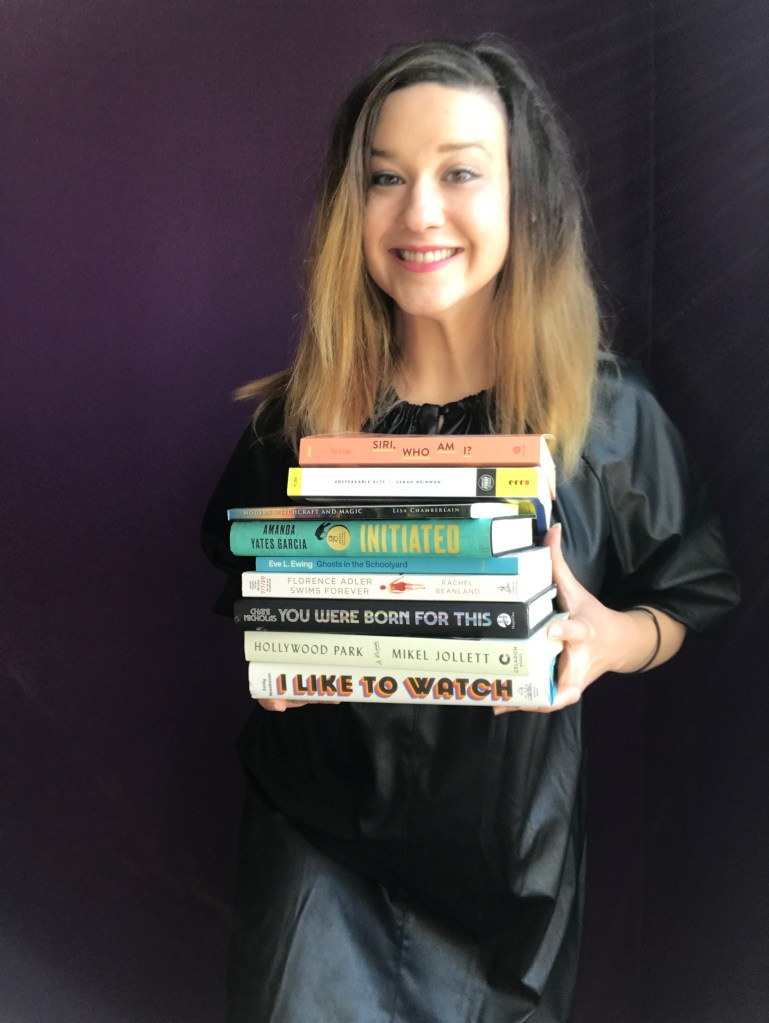
Woo hoo, part two! And I am a poet and didn’t know it! Just in under the wire, here are the rest of my 2020 quarantine reads, including a book I’m not quite done with but love so dearly and would make such a fabulous gift to yourself in the new year that I couldn’t not include it. The first review (Amanda Yates Garcia’s Initiated) is, ties with Mikel Jollet’s Hollywood Park as my favorite book(s) of the year. It is truly great, and I hope you read it, or would like to read any of these – I really didn’t have a bad apple in the bunch this year (though some apples that, maybe, I wouldn’t eat again). If you haven’t read the first half of my 2020 book reviews, check ’em out here. Happy reading, and have a happy new year with lots more goodies than just good reads, though of course I hope you have plenty of those too.
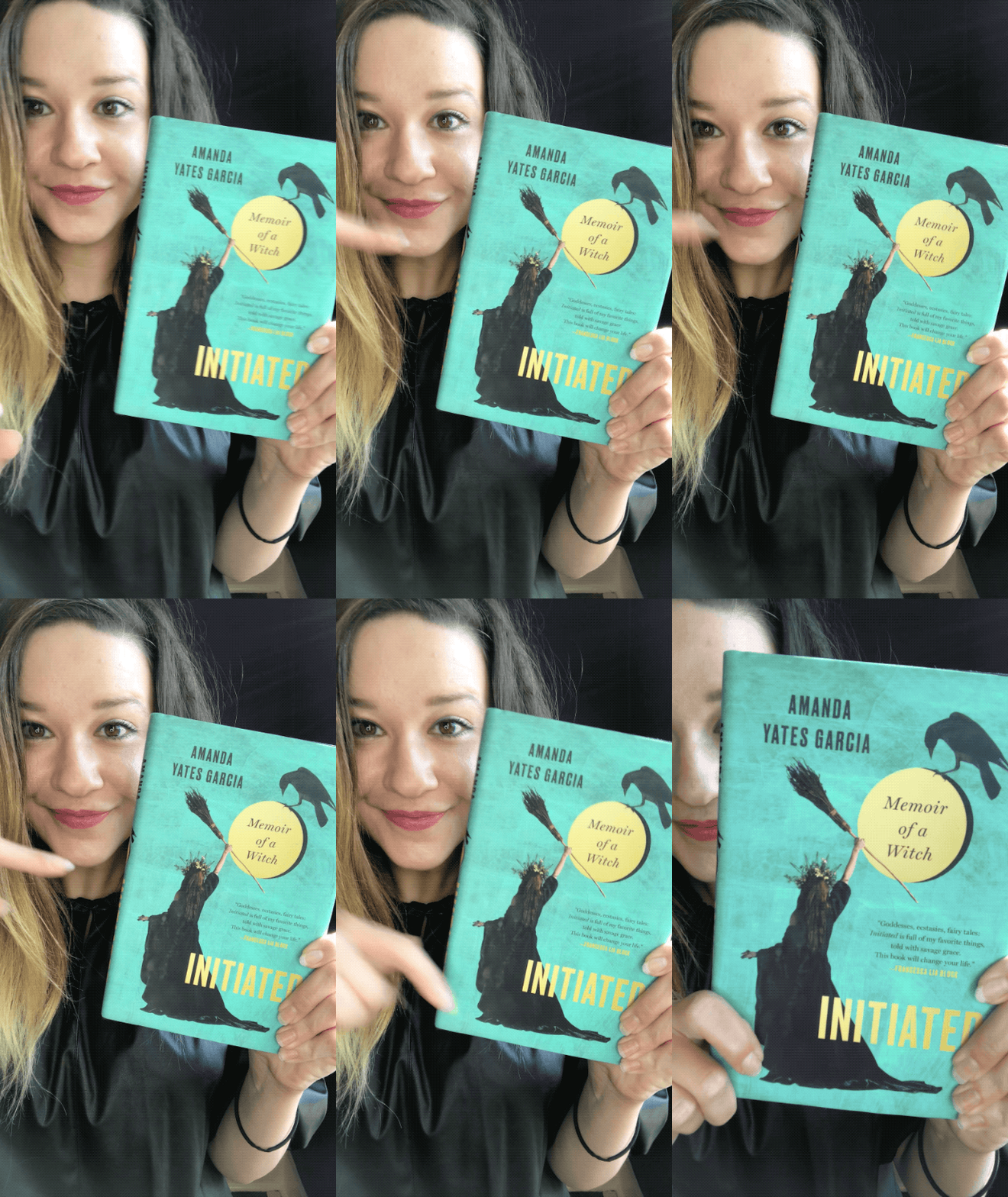
Initiated (Amanda Yates Garcia)
Oh wooowwww. Talk about a must-read, a totally surprise must-read that I (and I’m not trying to be rude, I think it’s just true) don’t believe a lot of people I know wouldn’t think to pick up. I’m here to tell you to pick it up and give it as birthday presents for the next year.
It’s actually more difficult for me to review books that I adore, through and through, because it’s so rare and the reasons are way more complex than when I don’t like something. I’ll try to keep it simple. AYG does that thing that takes memoirs from good to great, by getting so deeply personal and detailed in describing her own life that the themes she works through are absolutely universally relatable. They go beyond one person’s existence to a larger group of people, then an even larger group, then into politics and religion and basically this big fucking mess of a universe we live in but in which we don’t have a place.
Through this type of broadening perspective, she creates a tone of total comfort and relatability. I haven’t experienced even ten percent of what she has, yet her way of talking about the happenings of her life drives home the fact that, at the end of the day, we’re all more similar to each other than different. And, of course, there’s a healthy dose of magic, done in a way that is absolutely not cheesy, or silly. Not because she’s desperate for witchcraft to be taken seriously, and so writes about it in a way that’s appealing to the more “scientific” or skeptical people out there, but because she writes about it in a way that’s totally opposite. It’s earthy, it’s rich, it’s ever-present and matter-of-fact. Her determination to be utterly truthful gives everything mystical a weight; rooting her practice in defying the real world of capitalism, patriarchy, and white supremacy guarantees that you, too, can experience magic.
It’s incredible how seamlessly she goes from, as I said, the personal to the broader themes of oppression and persecution to witchcraft to folk tale allegory. Nothing seems jarring or out of place, it all fits together and at the end, the book is still very much a beautiful memoir. But it’s also a bit of a call to arms, and an effective one at that. It’s a subtly encouraging book, and you feel like she believes in everyone reading it as much as she knows the truth of her own story. Although the events are often dramatic, or traumatic, or sad, it’s not even remotely depressing – in fact, it’s very much inspiring.
The writing is gorgeous, which should be a given considering how much is successfully packed into it. Truly, a fantastic book. Love.
Eight Perfect Murders (Swanson)
There was something . . . choppy about this one, and I’m not referring to murdering style. When I reach back and look at the plot as a whole, I realized I’d expect a lot more slickness, a dash more cool. Listen, it’s a good thriller read, and it’s gonna whet that appetite for you if it’s your mood, but there’s something missing in the style of writing that I think would’ve sent it home.
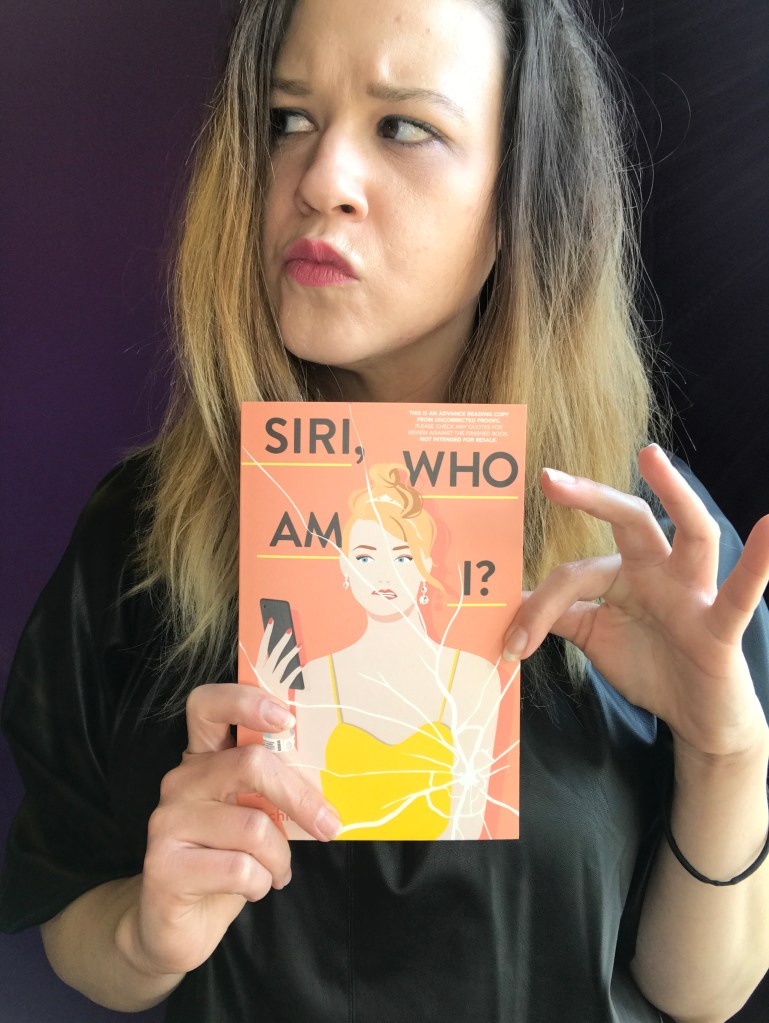
Siri Who Am I? (Tschida)
Well, okay! This is a book I read! What I needed, desperately, was something totally light and silly, and this delivered, and for that I’m grateful. I’m not of the opinion that every book you read has to be Something, changing your cellular makeup or making you Think, and that to judge everything based on that standard is to live a life of void of true fun. That being said, of course even stuff firmly in the category of fun can have issues with delivery, and while I ripped through this book with a skip in my step, that’s true of “Siri Who Am I?” as well.
The tone was a little too try-hard at times, and that’s sort of hard for me to admit because I think the author has a similar style and sense of humor that I have. There were times when I thought she could’ve gone just slightly deeper, slightly more meaningful, that would have added just enough dimension to elevate it from pure cotton candy to, perhaps, a banana split? Do people like those? Or has the banana split also turned in on itself as a existing purely as metaphor without an actual recognized existence? Anyway.
Some of the jokes were clunky, and at times made me cringe – not because they were offensive, I understood what she was doing, but they could have had more finesse. To put it bluntly, there was a lack of savvy or smartness that it’s clear could have been present. It actually came off like the commitment to the tone was really, really severe – almost like any nuance was taken straight out, because it seems almost difficult to not have more dimension when it came to the events she was describing.
This is worth a pick up for the escape you might need – I am a big fan of reading about super rich people when stuff gets rough, and this had the added “problem” of not really understanding why the character was a part of that world, and it was an interesting idea. It definitely set me up to look forward to giving the author’s future work a try, as her voice is so clear, so that’s a good thing.
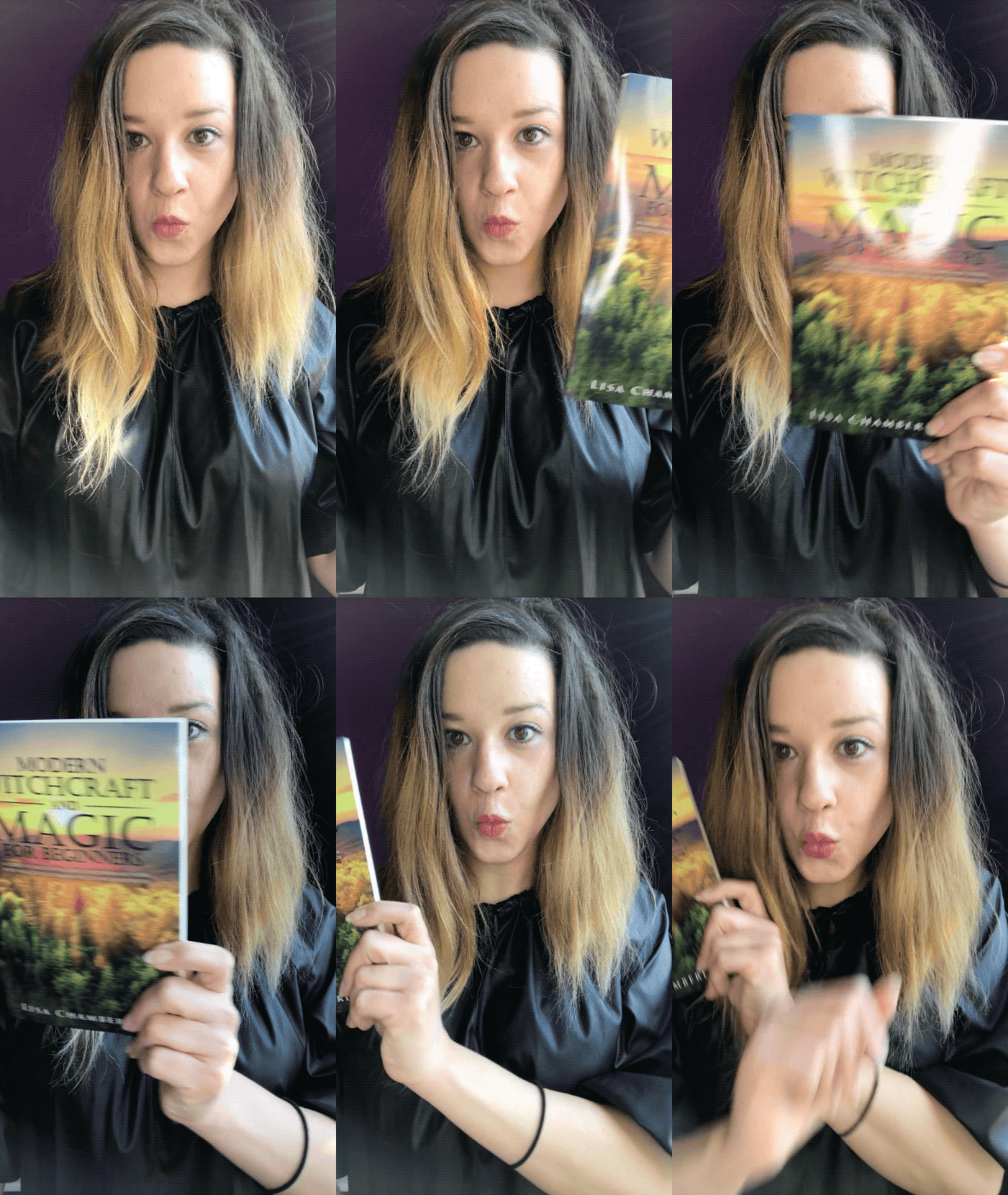
Modern Witchcraft and Magic for Beginners (Chamberlain)
I recently started participating in rituals with a well-known witch, and I was a bit surprised at how much comfort and reassurance it gave me. Kind of like scratching an itch you didn’t know you had? And I figured that I’d investigate that a bit, and literally googled books for getting started in witchcraft, and this was on it.
It’s a good start! Chamberlain sticks to the basics, laying out histories and different lines of thinking for practicing. The trouble comes, not her fault of course, from the history of witchcraft itself, which becomes muddled and layered and complementary and contradictory. It’s not easy to say, “These folks do this, these do this, etc.” It sounds silly, but I actually wish there was a sort of family tree outlining what went where in history, and, like, diagrams showing what influences what. It became a little hard to keep information straight, and there are a lot of names – which, again, is helpful and great and excellent to be all in one place. But it’d be nice to be able to flip to the start and say, “Oh, right, that’s the guy from late 18th century Europe” as opposed to the “person from mid-20th century America.”
I love how succinct it is, and also how totally neutral Chamberlain is when describing the different types of practice; you leave the book with literally no clue how she herself practices, which I think is really nice and a credit to her. Again: great starting point, and gets your mind going about a really difficult topic with lots of nuance.

Unspeakable Acts: True Tales of Crime, Murder, Deceit, and Obsession (Weinman, Editor)
I appreciated the variety of pieces this true crime collection includes, though I admit I didn’t really see the arc described by the editor in the intro. No matter, though, that doesn’t take away from the experience overall. I enjoy collections like this because it’s interesting to see different perspectives about crime through the various authors’ writing. And the writing of each piece is fantastic, with a lot of different subjects – some I haven’t heard of before, which is . . . surprising given my interests.
The piece that stuck out to me for the good reasons was “The True Crime Story Behind a 1970s Cult Feminist Film Classic,” about the real story behind Barbara Loden’s Wanda. Weinman (also the editor of the collection) did an incredible job of bringing misogyny back around to how we, as women, are both permitted and forbidden from telling our own stories, and I found myself googling everything I could about the filmmaker – and now I have a new hero.
A piece sticking out for the wrong reasons? The one about Ted Bundy (“The End of Evil”). Weird. I felt a righteousness from the author, like she was trying to really get me to feel bad for him, and . . . that’s not going to happen. The logic was so strange and circular, it wasn’t logical at all. The length of it hurt her case too; in describing the horror of this person, a true monster, and then attempting to bring it around to mental health or something . . . it just didn’t work, and actually irritated me. One could, perhaps, describe the suffering of psychopaths, I don’t doubt that there is suffering at all. But I don’t know it can effectively be done without denying or downplaying the unbelievable suffering they cause, especially in Bundy’s case. And without a large amount of cognitive dissonance, the clinging to the idea that this person has zero ability to control themselves, which is simply not true when they’re repeatedly breaking out of jail to torture and murder people. It left a bad taste in my mouth, is all, and it felt like I was getting a finger wag for something I didn’t know I did.
This is a solid collection for anyone into true crime, but I would caution against assuming that it’s just articles describing murders/murderers. It’s more of a collection of articles thinking about crime, and people, and our thinking about thinking about it, with crime being the link between meditations. You’ve got solid, straightforward pieces about, for example, Gypsy Rose Blanchard and the Slenderman murders; you also have pieces that step back and approach crime from an angle that’s ever present yet never described, like in “What Bullets Do to Bodies,” centering around a doctor who has spent her life treating shooting victims. Even if you think you’ve exhausted the genre, I’d be surprised if there aren’t at least a few pieces you haven’t come across yet, that are as much an important part of the topic as more standard articles.
You’ll Never Believe What Happened to Lacey (Ruffin/Lamar)
Oh, man. So glad I got an ARC of this. I feel like one of the cool kids. Amber Ruffin is such a star, and perhaps I will smugly brag to my kids when they’re all doing TikToks of her latest award winning special that I, once, got an early copy of her and her sister’s book, because I will have little to brag about, I guess, but I accept that. I truly accept that. I know my place.
First off, yes, the book is hilarious, and secondly, yes, it is incredibly smart, and thirdly, absolutely, it is meaningful and necessary reading about race. Those aren’t in any particular order, just more saying it because I don’t know, literary-wise, how often those three elements meet. It feels new, and fresh, despite describing the oldest and most everyday forms of discrimination and racism.
I am the New York City white progressive, and I think that if I hadn’t moved back to Pittsburgh three years ago, I would probably be even more shocked about what Lacey experiences on a daily basis. But yeah, I am somewhat ashamed to admit that I was still pretty f’in’ shocked and horrified. That’s a good thing though. I wouldn’t say the humor made it any more palatable, and that’s the genius of it; nothing isn’t said, nothing is shied away from. The humor sometimes lays in sharing the shock, but also the dry observation of something which feels yuckily common. It doesn’t give white readers a pass, and it seems (i can’t know for sure, of course) that it has tons of room, I think, for commiseration and connectedness for Black people who have experienced similar circumstances. The closeness of Lamar and Ruffin’s family really comes through, and just reading about a bunch of smart and funny people is nice too. It’s just brilliant how it kind of dips back and forth from the universal/broad to the universal/specific, and overall a great read.
We Keep the Dead Close (Cooper)
Woooo-weeeee. This is a long and complex book, and I feel like piecing out what I thought may also end up long and complex.
First, I can’t express the amount of respect and admiration I have for the author. Over ten years of research?! I legit have an adult coloring book page open under my coffee table that I started in June. Secondly, the writing it self is extremely good – intellectual, well-paced, thoughtful and sharp and moody. I plan on seeking out her writing for the New Yorker, it’s so good.
Cooper does an excellent job of expanding on the different themes surrounding this murder, and places Harvard well as a – if not the – main character. I never in my life would have thought that I’d do such a deep dive into mid-century archaeological and anthropological academia at Harvard, but there it is. I think that those parts, the description of this incredibly specific world, were what grabbed me the most. It could literally have been its own book.
I think that there is why it didn’t quite make it to a five-star, and actually sort of went dangerously close to a three-star for me by the end. A lot of people have mentioned in reviews about the jumping around in time, and honestly that didn’t bother me that much – it’s a pretty common structural technique that, to me, serves the nature of the story well. After all, Cooper literally was going back and forth in time, having to chase leads ten years ahead, then be forced to go backward to before the murder, etc., and doing all of that work in modern times. She is clear about how the telling of history is influenced by the teller of it, and parallels her own experience with archaeology. I took it as a pretty smart way of disclosing potential biases without taking the reader completely out of the story.
Anyway, the “problem” to me wasn’t that she jumped around, it was just that the book was way too long in general. I suspect that literally everything she included could have stayed to some degree – just describing it with a few sentences instead of a few pages, especially considering that she knew who committed the murder at publication. I get, though, that after ten years . . . gawd, how brutal it would be to trash so much of your life, in a sense. Getting rid of literal years of research. It would be tough, but it just is too bogged down at the end, and as a reader, I really couldn’t see the forest for the trees.
At the same time as it felt convoluted in the last third, it also felt rushed, as if Cooper really was trying to insert the latest, final development in a way that made sense but also, dammit, she has a deadline and it’s been like ten years, “Let’s do this!!” I would’ve loved more about the actual killer, maybe an expansion on the themes she mentioned regarding the stark differences between him and Jane Britton – growing up in two opposing worlds, he a stereotypical criminal and she an Ivy League doctoral student.
Overall, I felt the respect and love Cooper had for her subject; it comes through the pages, and she’s clear about her complicated feelings about it. I don’t know that true crime stories about women often go to such lengths to recreate their person, and their world. This really is a triumph in that sense, and even though it got bumpy at the end, and certainly isn’t perfect, I hope it’s example of where the genre is going.
A bonus! I did not finish this last book yet, but it’s too good not to mention. I highly recommend it, especially as a lovely way to start a new, very welcome year.
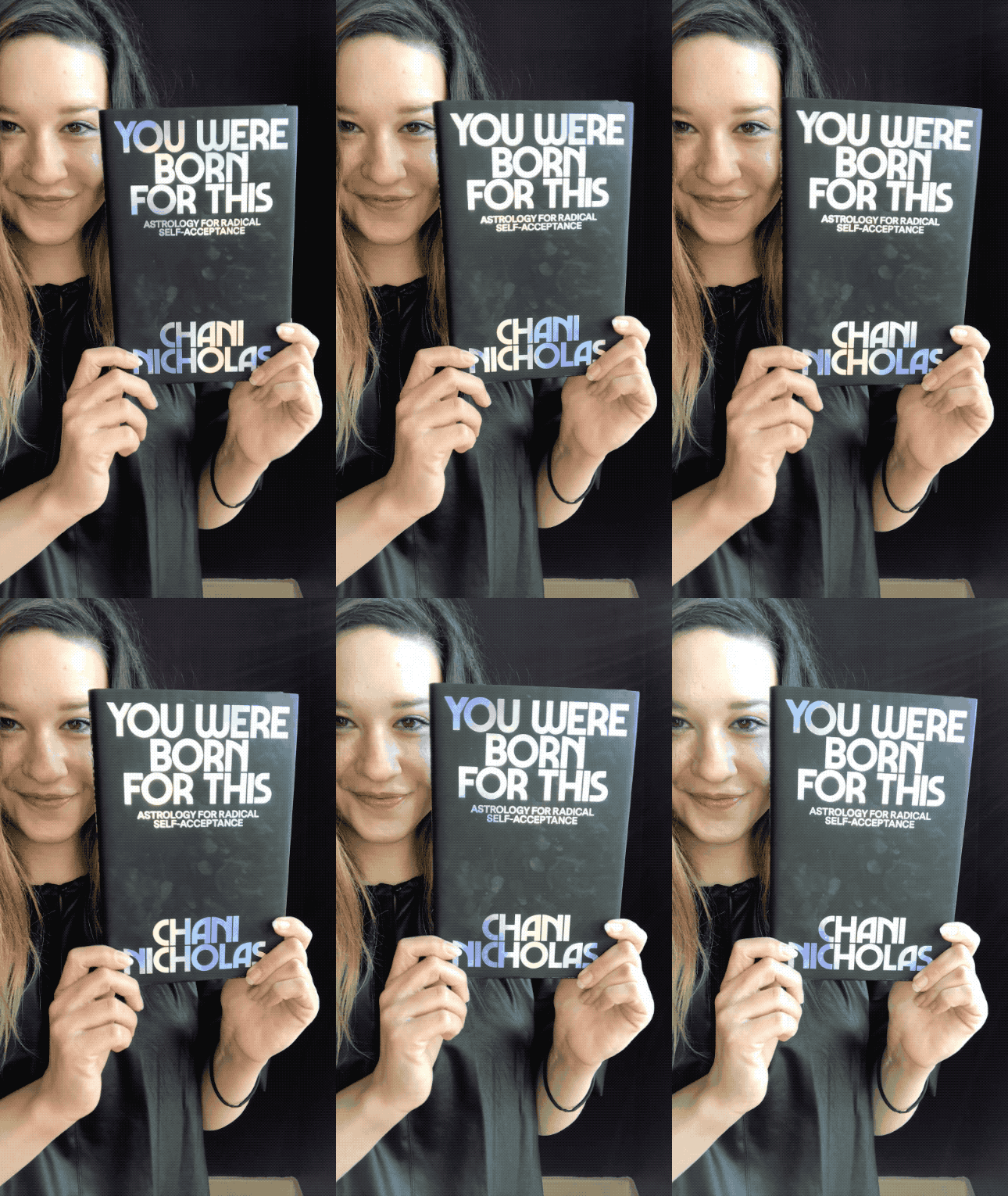
You Were Born for This (Nicholas)
Oh my gawwwwwddddd this book is so good! I can’t say a ton so far, because it functions sort of like a workbook (though I wouldn’t dare write in it), and I’m not done yet, but what a fantastic approach to astrology. So fresh and different and inspiring.
This book goes beyond just, “Your moon is in Aries, so you’re like this,” and asks questions and prompts thinking that turns that information into action. So, assume, for a moment, that you think astrology is real and all of those descriptions are accurate – essentially, you read, “You, as an Aries, are blunt, have a temper, and are a leader.” And you agree with that! You see that in yourself! Great! But – what does that really do for you, anyway? So what?
Now imagine through therapy or something you come to the same conclusion: I’m blunt! I’m a leader! I have a temper! The next logical step is to figure out what to do with those traits, how to embrace them, embrace yourself, utilize them for fulfillment. And this book does that! The context of astrology is, of course, not for everyone I suppose, but I use that example as a way of explaining why this book is so different and great.
And, of course, you can take what you want and leave the rest. It doesn’t tell you your future, it doesn’t act like literally anything is inevitable, it’s just, “Hey! You! You’re cool! Every part of you is working for you in some way – let’s make it work even better.” And it makes you feel really good in the process! Yay, get it!
If you like my nonsense, more of it is available on Instagram, Twitter, and Facebook. Email me at whatthehellisonmyface at gmail dot com.
 What the Hell is On My Face?